
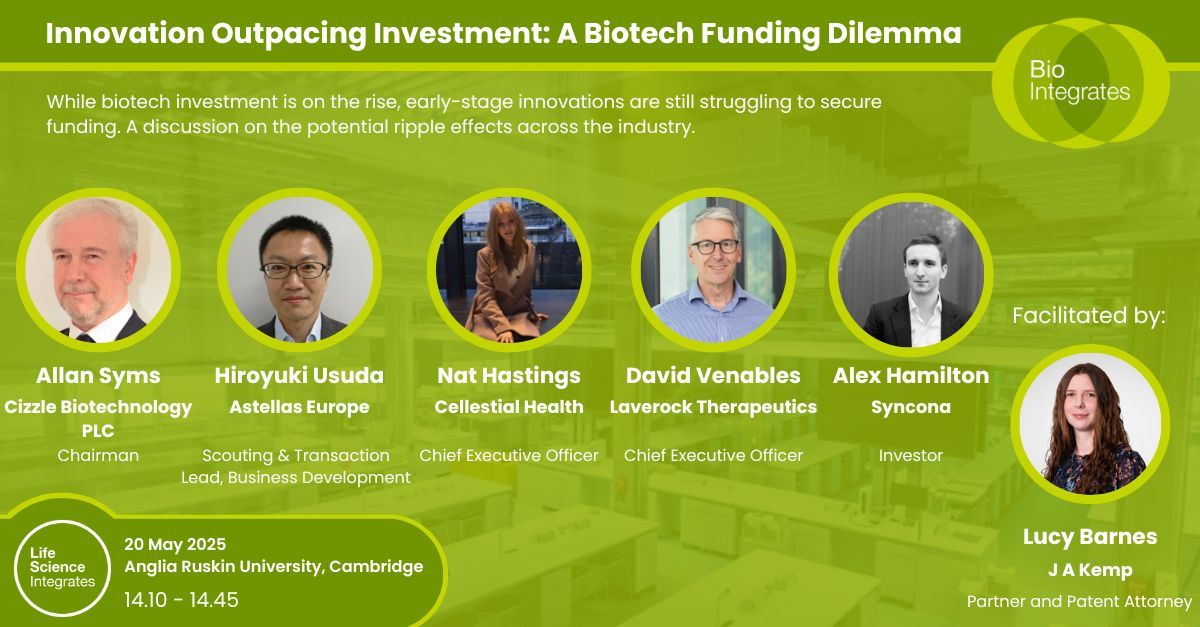
Last week Dr Nat Hastings, CEO of Cellestial Health, had a pleasure of contributing to a panel discussion on early-stage biopharmaceutical company funding at #BioIntegrates. This conference was organised by Life Science Integrates, hosted at the Anglia Ruskin University in Cambridge.
Cellestial had a unique perspective to bring to this discussion – that of an academic spin-out company from the University of Cambridge. Additionally, Cellestial has experience of collaborating with academics in other institutions outside of Cambridge as a commercial partner. In an environment where early-stage VC funding is scarce, University collaborations and charity-backed grants can provide new avenues for generating the data and traction to progress to the next stages and demonstrate investment-readiness.
Both the spin-out status and that of a commercial partner in an academic collaboration bring unique challenges to an emerging corporation, but also specific advantages and opportunities. Dr Hastings covered those during the discussion.
Opportunities:
- Academic grants accessible to the founding team at the University may be better suited for testing very novel, or very fundamental scientific ideas which will pave the way for and de-risk the commercial plan
- Academic partnerships may allow access to cutting-edge disease models and resources to validate the concepts before scaling them
- Institutional and high-profile charity support can improve credibility and attract KOLs in the field, which is especially relevant for the first-time founders
- Technology transfer offices (TTOs) may provide financial and other (e.g. lab / office space, networking, regulatory consultants) support to their spin-outs, reducing the costs of acquiring these separately
- Scientific credibility can open doors for additional company funding avenues beyond traditional VC and Innovate UK grants, including charities and individuals / family offices with a strong focus on specific disease areas which are driven mainly by the impact rather than financial returns
Challenges:
- Some University TTO terms may be seen as prohibitive, especially for global investors; it is best to come to the TTO negotiations knowing the market standards and bring own legal counsel – think about the legal structure that would enable future funding rounds, not only the immediate round
- University TTO negotiations may take time; it is good to start the spin-out process early and avoid academic partnerships for the “critical path” activities of the business
- Academics may want to publish their findings and may not be fully aware of the value of the IP; engage them in these discussions early and gently educate on what constitutes disclosure (common pitfalls include conference posters / proceedings, student dissertations, pre-prints, and awarded grant abstracts / titles)

Some academic founders then become interested in continuing on the commercialisation journey, and a few will do exceptionally well by applying a variety of transferrable skills. However, many would find that the commercial dynamics are very different from the world of fundamental scientific research. How can the academic founding team assess if managing the company is the right move for them?
- Management team does not necessarily equal technical / clinical / academic experts in the field!
- It is important to engage people with commercial expertise from early-on to assess the market fit of the proposition, no matter how novel the idea is scientifically and even how strong the IP is – and that means hands-on experience of building a company to an exist, not just a relevant degree
- Identify gaps in the team and highlight risks – chances are, investors can already see them; showing that the founding team see them as well brings credibility rather than undermining it
- Academic founders would benefit from a network of people who are a step ahead in the commercial terms and learn what exactly their commercial counterparts do; it may not be the same as what academics do to run a lab
- Managing a company takes a significant time and effort; there may need to be a careful evaluation and choice to be made between the academic vs commercial career
- Sometimes investor feedback of “come back with more data” means “come back with a more credible team”; it is prudent to consider this if it feels that there is no traction despite strong science
Dr Hastings summarises:
In academic communication, you write “about something”.
In commercial communication, you write “to someone”.
What is the action point that stems from the knowledge you’ve produced and who is going to action it?
Does it resonate with your experience, or have we missed something?