
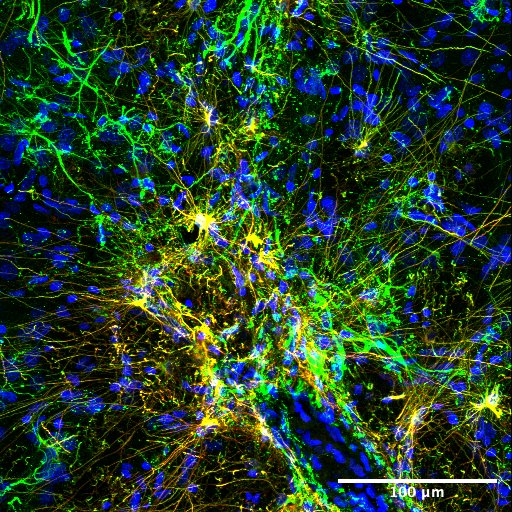
There are many ways to protect astrocytic networks.
Drugs can work well, with a major caveat – they rely on the drug target being available. If cells are irreparably lost or damaged, it could be that the only way to restore the network balance is by supplying new, healthy cells.
Dr Nat Hastings explored the nascent field of astrocyte transplantation for the treatment of brain disease in depth in the “Best Review in 2022” at Cell Transplantation:
The founding team of Cellestial also worked on generation and characterisation of human stem cell-derived astrocyte subtypes:
Neuronal and stem cell transplants have been used in clinical trials in Parkinson’s with promising results, and astrocyte transplantation has been successfully piloted in Parkinson’s models. So, why is the first product of Cellestial not an astrocyte cell therapy?
Dr Hastings comments:
Cell transplantation is a rather invasive approach, which restricts the scalability and the number of patients who can benefit from it. Most cells would not survive long-term, so the network-restoring benefit is uncertain. Further, we still have a lot to learn about which astrocyte subtypes exist in the healthy human brain and what their functions are; without this information we cannot easily decide which astrocyte types should be used therapeutically. Finally, diseased brain environment can make newly implanted, normal cells unhealthy.
With this in mind, we think that a drug is likely to benefit more patients, quicker. However, unique opportunities may present when multiple treatment approaches combine.